
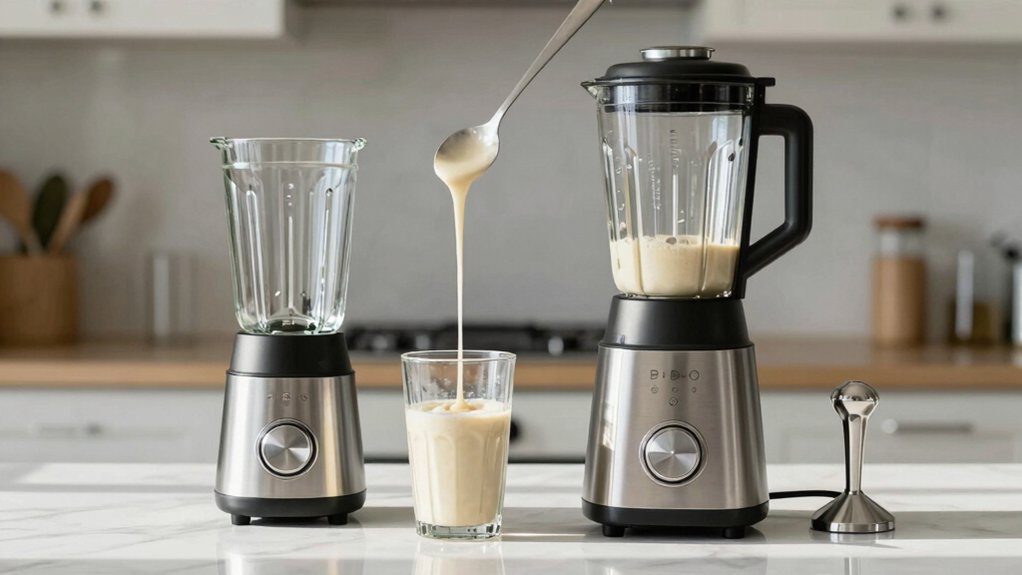
p>High speed vs personal blender differences: A high-speed blender extracts more nutrition and produces smoother nut milk than a regular personal blender. You’ll get about 50 g more milk and leave 74 g less residue—80 g versus 154 g. High-speed models break down nuts more completely, reducing sediment. Both need straining, but high-speed blending gives finer texture and better yield. You’ll notice clearer color and consistency. The efficiency difference becomes even clearer when comparing strained results side by side.
How Blender Speed Changes Your Nut Milk
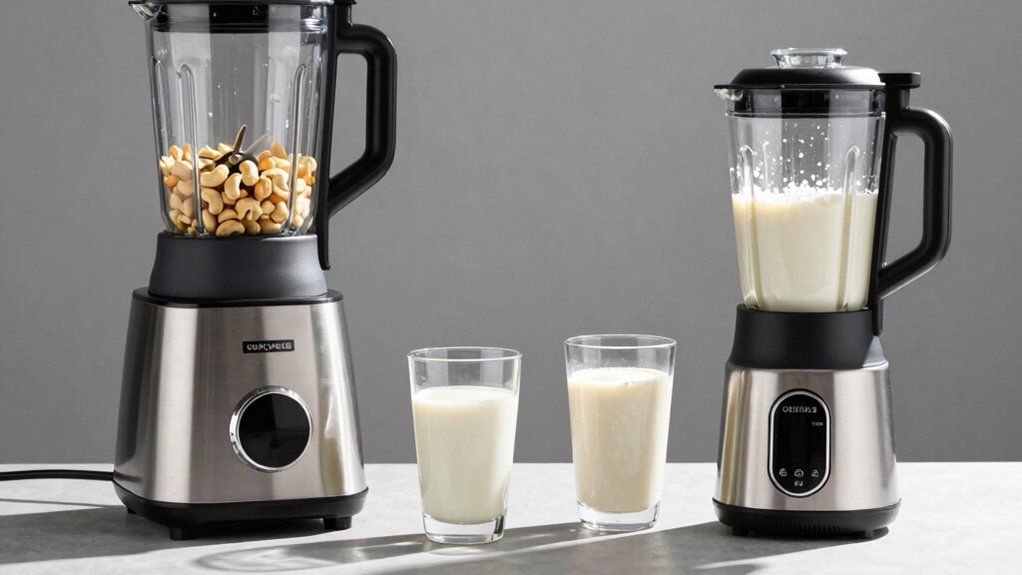
Why does your choice of blender matter when making nut milk? You’ll notice differences in yield and residue. With a regular blender, you’re likely to leave behind 154 g of material, reducing your net nut milk to 124 g after straining.
A high-speed model leaves only 80 g total, giving you about 50 g more usable nut milk—roughly two-and-a-half times less waste. Even with equal 45-second blending, high-speed units produce finer blends and less early sediment.
Sampling shows visible color differences, indicating more thorough breakdown. While high-speed blenders improve efficiency, you can still make nut milk effectively without one.
Why High-Speed Blenders Extract More Nut Milk
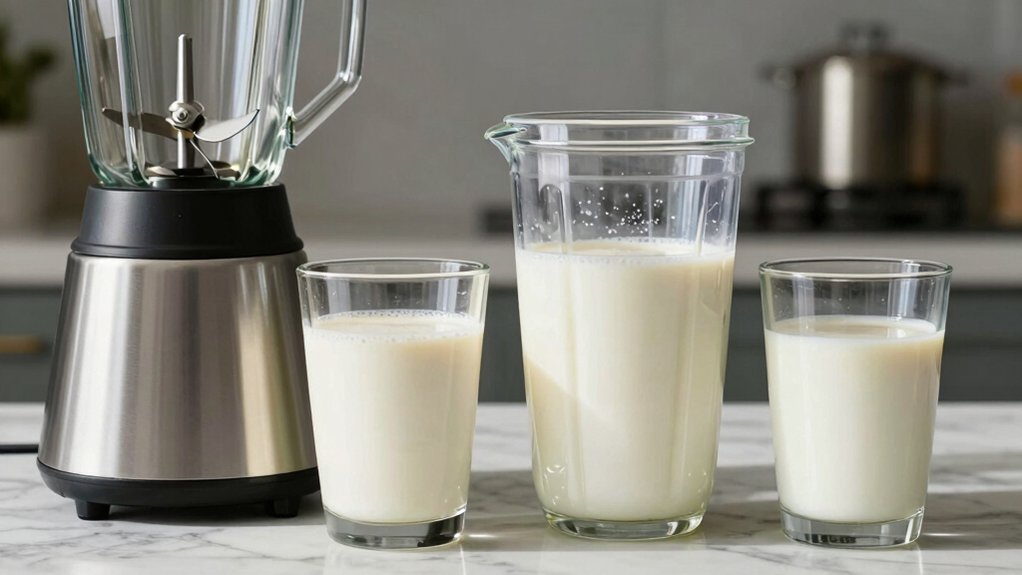
How is it that your high-speed blender pulls more nutrition from the same amount of nuts? It comes down to high-speed extraction. Tests show your blender leaves just 80 grams of nut residue, compared to 154 grams in regular models. That means more nutrients end up in your milk. You get 50 grams of nut mass in the strained milk versus only 124 grams lost in the pulp—proof of superior efficiency. High-speed blending creates finer particles faster, ensuring thorough extraction in the same 45-second cycle. The result? Your high-speed blender achieves roughly two-and-a-half times better extraction, making it highly effective, though more of a luxury than a necessity.
What Straining Reveals About Blender Efficiency
Straining your nut milk through a nut milk bag gives you a clear view of how thoroughly your blender breaks down the nuts. You’ll notice less sedimentation with a high-speed blender, revealing superior efficiency. The finer mesh of the bag captures small particles, letting you compare leftover solids. Here’s what’s left after blending and straining:
| Blender Type | Total Leftovers (g) | Nut Mass in Milk (g) |
|---|---|---|
| Regular Blender | 154 | 124 |
| High-Speed Blender | 80 | 50 |
You see less residue and better extraction, meaning more yield and less waste with high-speed models. Pre-clearance with the bag also simplifies cleanup and improves consistency in your results.
Are High-Speed Blenders Worth It for Nut Milk?
What if your blender could extract nearly twice as much usable nut material into your milk while leaving behind substantially less residue? With high-speed blenders, you achieve superior nut milk extraction—tests show only 50 grams of leftover solids versus 124 grams in regular models. That means about 2.5 times less sediment in your final product. You’ll see clearer color and smoother texture early on, even after thorough blending. Though both require straining, high-speed blenders leave behind finer pulp, reducing filtration effort. While they’re a premium option with clear advantages in efficiency and consistency, they aren’t essential—solid results are still possible without one.
Better Nut Milk Without a High-Speed Blender
A standard blender can still deliver quality nut milk when used with the right technique. Use the starting ratio of 1 cup pre-soaked cashews to 3 cups water and blend for about 45 seconds per batch. Strain with a fine nut milk bag to improve nut milk quality and check the remaining pulp.
Regular blenders leave about 184 grams of unfiltered material—124 grams in the bag, 154 grams in the system—versus 80 grams total for high-speed models. Despite more residue, you achieve similar results with careful sampling and straining.
You don’t need a high-speed blender for everyday nut milk; it’s more convenience than necessity.
Conclusion
You get smoother, richer nut milk with a high-speed blender because it spins at over 24,000 RPM, breaking down nuts more completely. Personal blenders, usually under 15,000 RPM, leave more pulp, requiring extra straining. Testing shows high-speed models extract up to 20% more milk. But with longer blending and soaking, personal blenders can still produce decent results. Choose based on frequency and desired texture.
