
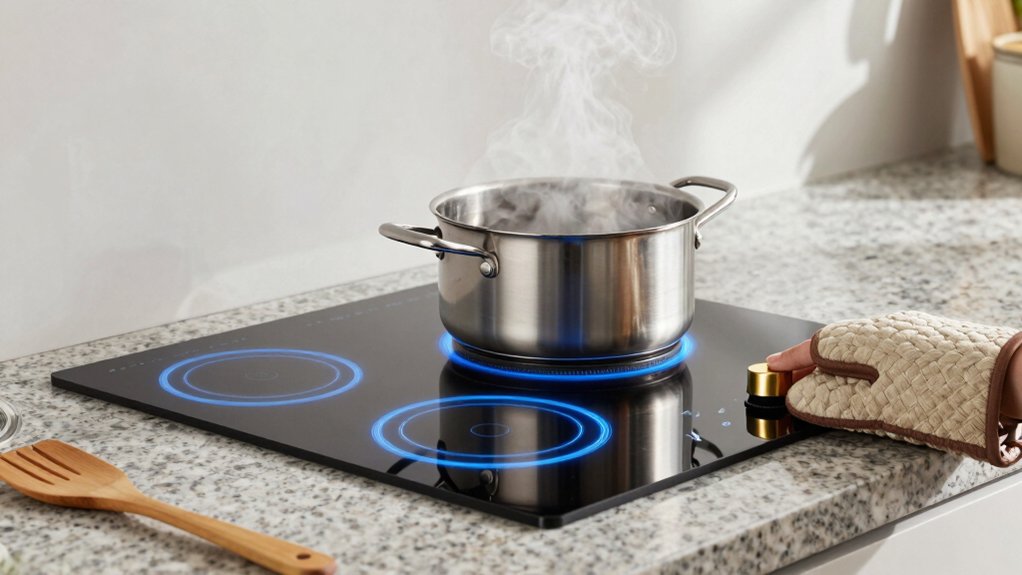
Turn on the cooktop with the power button, then place a magnetic, flat-bottomed pan on the cooking zone—verify compatibility using a magnet test. Match the pan’s size to the heating element (5–9 inches) for efficiency. Select your cooking zone and adjust heat levels from simmer to boil. Heat generates instantly in the pan, not the surface. The cooktop stays cool, with residual heat indicated by a warning light. Efficiency reaches 90%, boiling water up to 40% faster than gas. Explore further to discover safety perks and cost-saving incentives.
How Induction Cooktops Work
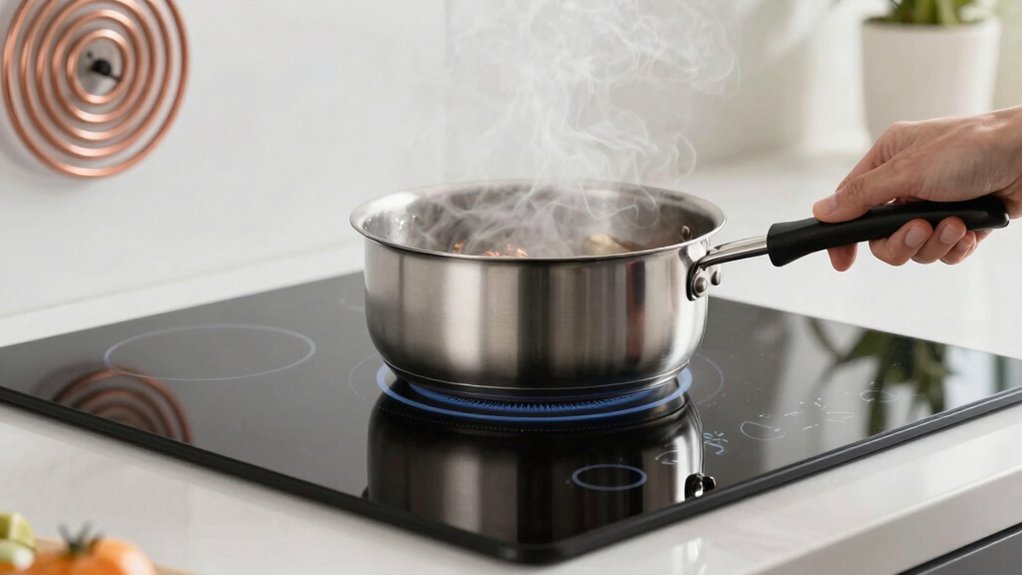
How does a stove heat food without getting hot itself? An induction cooktop uses an electromagnetic field generated by a copper coil beneath the glass surface to create heat directly in the cookware. This process, called induction heating, requires ferromagnetic cookware—like cast iron or magnetic stainless steel—so the cookware base interaction can convert electrical energy into heat through resistance. The heat generation in cookware happens instantly, while the glass surface stays cool. There’s no traditional heating element; instead, the electromagnetic field targets only magnetic cookware, ensuring efficient, precise cooking with minimal wasted energy.
Check Pan Compatibility With a Magnet
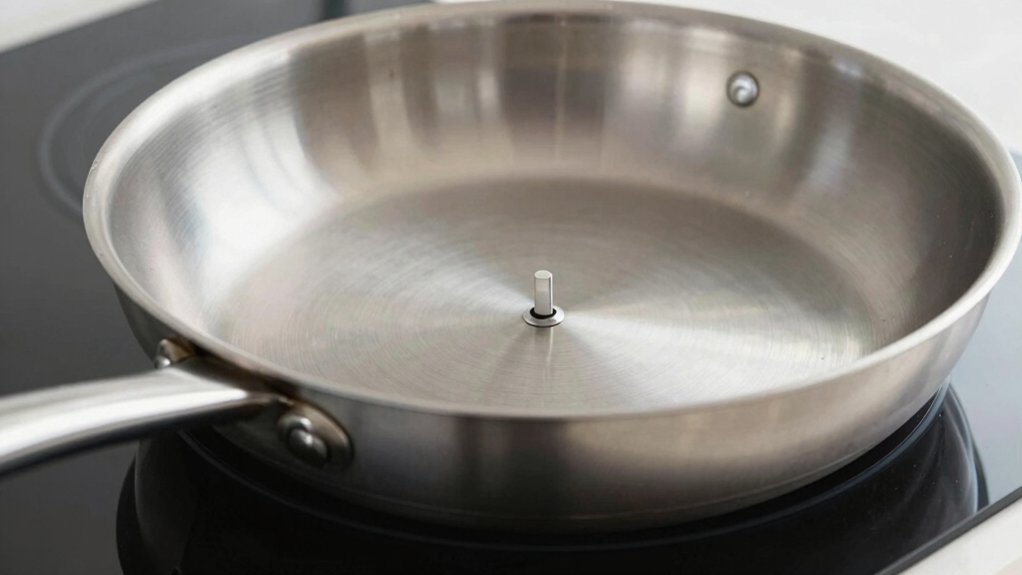
Why might your favorite skillet fail on an induction cooktop? It likely lacks the ferrous metals needed for induction cooking. Check pan compatibility with a simple magnet test: if a strong magnet sticks firmly to the base, your cookware is induction-compatible. Look for induction-friendly cookware like cast iron or magnetic stainless steel. Use a flat-bottom pan to ensure full contact with the surface. Match the base diameter to the heating element size—usually 5 to 9 inches—for efficient heating. Non-magnetic materials like aluminum, copper, or glass won’t work unless they’ve a clad, magnetic base. Always confirm before buying new induction cookware.
How to Use an Induction Cooktop in 5 Steps
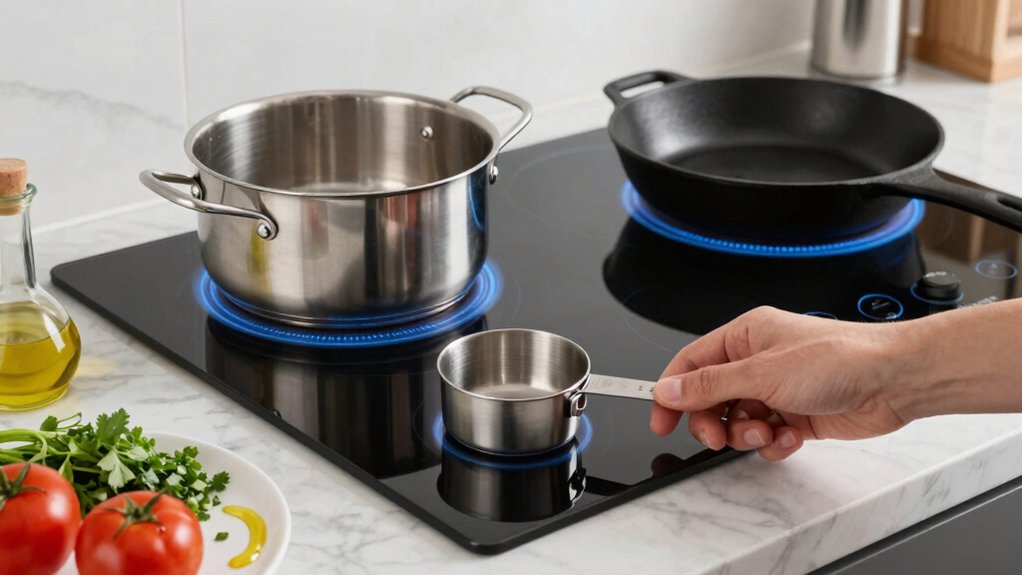
Once you’ve confirmed your cookware passes the magnet test and is ready for induction cooking, using the cooktop itself becomes a simple, step-by-step process.
First, press the power button to activate the induction cooktop and wait for the indicator light.
Press the power button to turn on the induction cooktop and wait for the indicator light before placing your cookware.
Next, place your induction-compatible cookware—complete with a ferromagnetic base—on the heating element, matching the cookware diameter to the zone.
Use the control panel to select the cooking area and heat level, whether you’re simmering or trying to boil water quickly.
Choose a cooking function, which may include an auto-shutoff feature after ten minutes of inactivity.
Finally, turn off the unit using the power button and wait for the Hot Surface Indicator to disappear before cleaning.
Is Induction Cooking Worth It?
What sets induction cooking apart—and whether it’s truly worth the investment—comes down to performance, efficiency, and compatibility. Induction uses a magnetic field to generate heat directly in ferromagnetic cookware, offering fast heating and a cool surface, enhancing safety. You’ll see up to 40% faster boil times compared to gas or electric. Energy efficiency is higher due to direct transfer, with precise control and quick responses. For best results, use flat-bottomed pots and check cookware compatibility. While upfront cost may be higher, federal cost and rebates—like those from the Inflation Reduction Act—help offset prices, making induction cooking a smart, efficient choice for modern kitchens.
Conclusion
You now know how induction cooking works and how to use it safely and efficiently. By checking pan compatibility with a magnet and following five simple steps, you can cook with precision. Induction heats faster than gas or electric—boiling water in about 3 minutes versus 7 on electric—using 10–20% less energy. With proper care, your cooktop lasts over 10,000 hours. It’s a smart, efficient choice for modern kitchens.
