

Test your tap water to identify contaminants like lead, PFAS, or nitrates—especially if you have a private well. Use results to choose an NSF-certified filter: go for NSF 53 for lead, NSF 58 for PFAS. Pick a pitcher for taste improvement, countertop for balance, or under-sink for high-capacity needs. Check certifications on the NSF Directory to verify claims. Consider long-term costs—some pitchers cost over $400 yearly in replacements. Factor in filter life, flow rate, and household usage. Compare systems like AquaTru (6-month filters) or iSpring (50+ GPD) to match your kitchen’s demands. A properly sized, certified system ensures clean, safe water tailored to your home’s needs, and smart maintenance keeps it performing—there’s more to consider for lasting protection.
Test Your Tap Water First
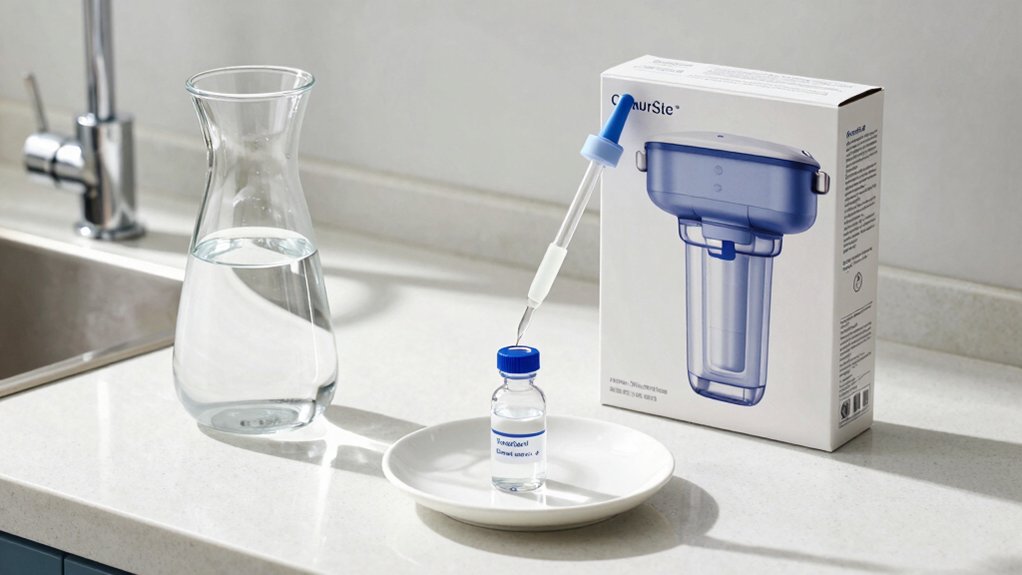
Why risk filtering the wrong contaminants? You need to test water first to know what’s really in it. Check your utility’s water quality report or conduct water testing—especially if you use a private well. These tests reveal contaminants like lead, PFAS, nitrates, or chlorine byproducts. Once you identify the pollutants, look for filters with specific NSF certification ratings, like NSF 53 for lead or NSF 58 for PFAS. Filter certification ensures effective contaminant removal. Don’t guess—use results to guide your choice. Yearly testing, plus checks after taste or odor changes, keeps your strategy current. Confirm you’re targeting the right hazards with verified filter certification.
Match Your Filter to Key Contaminants
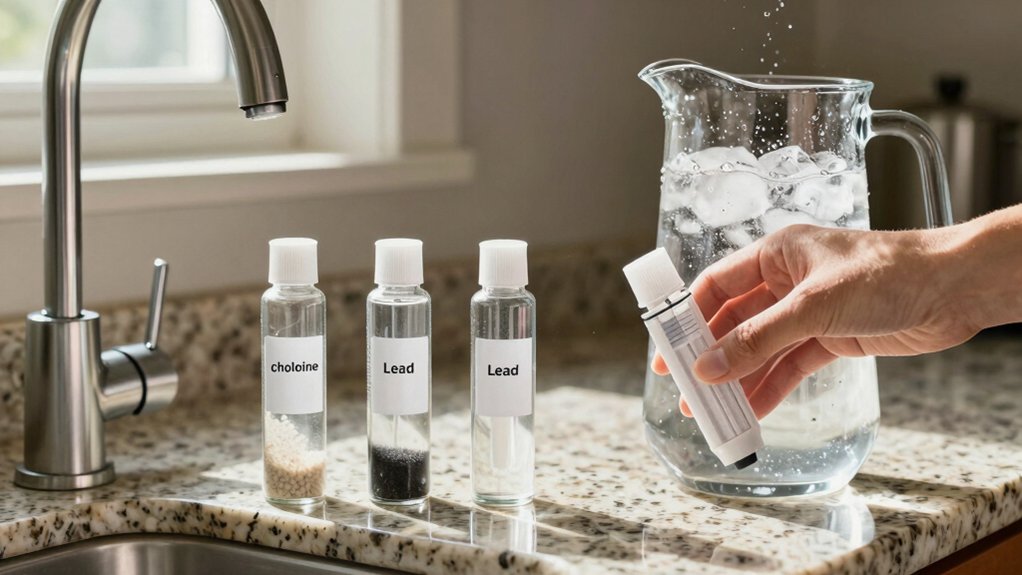
Now that you know what’s in your water, you can choose a filter designed to tackle those specific contaminants. Focus on systems with NSF certification for verified contaminant reduction:
Choose a filter that targets your water’s specific contaminants—prioritize NSF-certified systems for proven, reliable contaminant reduction.
- For lead, PFAS, and fluoride, pick RO systems like AquaTru—certified under NSF 58, using reverse osmosis for up to 95% fluoride reduction.
- If taste and odor are your main concerns, carbon filtration filters with NSF 42/53 ratings effectively reduce chlorine and byproducts.
- Always check third-party verification to confirm performance claims, especially for contaminants like microplastics or arsenic.
RO systems offer broad protection, while carbon suits simpler needs.
Choose Pitcher, Countertop, or Under-Sink
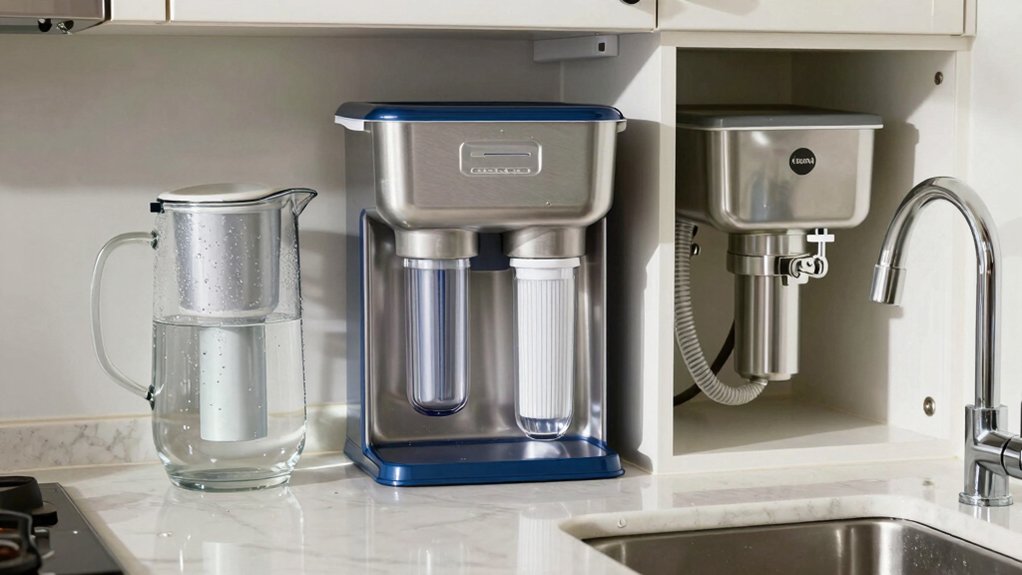
How do your daily habits and kitchen setup influence the type of water filter that’s right for you?
| Type | Installation Ease, Filtration Speed, Contaminants | ||
|---|---|---|---|
| Pitcher | Easy setup, slow speed, improves taste and odor | ||
| Countertop | Moderate installation, medium speed, broad certification (NSF 42/53/58) | ||
| Under-sink | Complex installation, fast flow, high-capacity contaminant removal | ||
| Example | Brita | AquaTru | iSpring |
| Best for | Taste | Tap integration | Hidden high-performance |
Choose pitcher, countertop, or under-sink based on space, installation ease, filtration speed, and needed certification. Pitcher filters suit simple taste improvement; countertop and under-sink systems tackle more contaminants with varying installation demands.
Trust the Label: Look for NSF-Certified Filters
When selecting a water filter, relying solely on marketing claims can lead you astray—instead, look for NSF certification to ensure the product delivers on its promises. NSF certification provides credible validation through third-party testing, confirming actual contaminant reductions.
- Check the NSF Certification Directory to verify filter certification for standards like 42 (taste/odor), 53 (cyst/chemical reduction), 58 (RO performance), and 401 (emerging contaminants).
- Match the filter’s certified contaminant reductions to your specific water quality needs.
- Always cross-check the label claims with the official NSF listing to confirm performance.
This ensures you get proven, not just promised, results.
Compare Long-Term Filter and Replacement Costs
While upfront price matters, you’ll save more over time by comparing long-term filter and replacement costs across systems. The AquaTru, for example, offers a countertop RO system with filter life of 6 months for pre/carbon stages and 2 years for membrane replacement, keeping annual filter costs manageable.
In contrast, the Pur Plus 11-Cup Pitcher has much higher replacement costs—up to $432 per year at high usage. Under-sink vs countertop setups like the APEC ROES-50 have greater maintenance demands and water waste, raising long-term costs. Whole-home system options like Springwell CF cost $1,015 upfront but reduce per-gallon expenses. Choose based on both filter life and ongoing replacement costs.
Install and Maintain With Ease
What if setting up your water filter didn’t require a plumber or a toolbox? With the AquaTru countertop RO system, you can install it yourself in minutes. Enjoy ease of use and low maintenance thanks to clear guidance and top-tier design.
Skip the plumber and setup hassles—AquaTru installs in minutes, delivering pure water with simple, intuitive design.
- Replace pre/carbon filters every 6 months and the RO membrane every 2 years for optimal performance.
- Rely on NSF certifications (42, 53, 58, 401) to guide filter replacement and verify quality.
- Plan around its flow rate—3 quarts purified per gallon wasted—balancing efficiency with daily needs.
Maintenance stays simple, with straightforward tank filling and wastewater disposal, making AquaTru a smart, self-sufficient choice.
Size Your Filter for Your Household Needs
How much filtered water do you actually need each day? Match your filter’s gallon-per-day capacity to your household demand. For high daily water usage, choose under-sink capacity or whole-house filtration. Consider storage needs and space:
| Countertop vs Under-Sink | Filter Production Rate |
|---|---|
| Small, portable pitchers | 0.5–1 GPD (RO systems) |
| Spacious under-sink units | 50+ GPD (whole-house) |
Larger systems meet higher system flow rate demands. Always check cartridge replacement interval and balance under-sink vs. whole-house filtration based on your household’s filtered water needs.
Conclusion
Choose a water filter that fits your household’s needs and water quality. Test your tap water to identify contaminants like lead or chlorine, then pick an NSF-certified model that targets them. A pitcher works for small households, while under-sink systems suit larger families. Replace filters every 2–6 months, costing $30–$70 annually. Prioritize ease of installation and maintenance to ensure long-term use and clean, safe drinking water.
